Black History Month 2026: An Exhibition of Stories, Faith and Memory
As part of Black History Month 2026, the Diocese of Chichester used its own local history and context to celebrate the stories, witness and legacy of Black men and women whose lives are woven into the history of Sussex and the wider Anglican Communion.
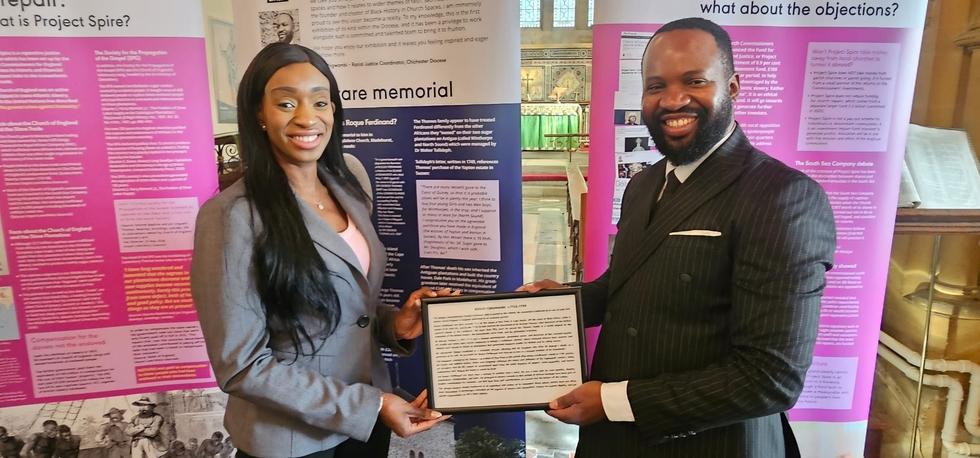
(pictured above is Alysia and Vitalis with the Roque Ferdinand plaque.)
The Black History in Church Spaces exhibition opened at St Luke’s Prestonville and brought together stories that encouraged reflection on faith, identity, remembrance and belonging within the Church.
The exhibition shared the story of the SS Mendi, commemorated through the memorial plaque at St John the Evangelist, Newtimber, honouring the more than 600 Black South African servicemen who lost their lives in 1917. It also featured the life and witness of Olaudah Equiano, whose Christian faith informed his campaign against slavery, and highlighted Project Spire, the Church of England’s work for healing, justice and repair as it seeks to address difficult historical legacies and build a more just future. Alongside this, the exhibition also honoured the Uganda Martyrs, whose courage and faith continue to inspire Christians around the world, demonstrating the global and interconnected nature of the Anglican story.
The exhibition concluded with a commemorative service at St Mary’s Church, Slindon, followed by the dedication of a plaque to Roque Ferdinand at St Mary Magdalene Church, Madehurst. Roque Ferdinand’s story formed a central focus of the exhibition because his memorial is one of the very few surviving eighteenth-century memorials to a Black man in a Sussex parish and in the Church of England. As a servant and formerly enslaved man, his memorial provides rare and tangible evidence of Black presence within the history of Sussex, challenging assumptions that Black history exists only elsewhere or outside the life of the Church.
The exhibition was well attended and received overwhelmingly positive feedback from visitors across the Diocese. One attendee reflected: “This project also shows what is possible when we approach contested heritage together: historians, community groups, the Church, and local people, working side by side with honesty and care.” The success of Black History in Church Spaces has established it as a new diocesan initiative that brings Black history directly into church communities. Building on this momentum, the exhibition will travel across the Diocese, supporting parishes to explore their local histories and uncover the Black presence, stories and contributions woven into the life of their churches.
Kwesi Ochosi, project co-ordinator and archivist at Lambeth Palace Library, was the keynote speaker at St Luke's. He talked about the importance of archives, memory and the stories preserved within the Church.
Professor Alan Lester, who was instrumental in supporting the project, was in attendance. He said: "Whether churches are tiny rural parishes or big urban centres, all of our churches are densely connected with Britain's imperial past. It is a deeply welcoming, culturally enriching experience to explore the past together."
Alysia-Lara Ayonrinde, Interim Deputy Director of the Church of England’s Racial Justice Unit, also spoke at the commemoration. Her address, Healing, Repair, and Justice as Acts of Faith, explored how remembering overlooked histories can lead to meaningful change.
She said: “Black history is not something that happened somewhere else. It is here. In our villages. Our communities. Our parish records. Our churchyards. And sometimes, quite literally, written upon the walls of our churches.”
Reflecting on the life of Roque Ferdinand, she added: “Roque was more than his years of service. More than the words inscribed in stone. He was a human being, created in the image of God, with a life, a dignity and a story entirely his own.”
Alysia encouraged those present to see remembrance as the beginning of responsibility: “Healing begins when we are courageous enough to tell the truth, compassionate enough to listen, and humble enough to be changed by it.”
Daniel Lee, Diocesan Church Buildings Support Officer, shared his reflections on the Black History Month Closing Ceremony at Slindon and Madehurst. He said:
“Confronting contested heritage takes an everyday kind of bravery, and the parishes should be commended for their efforts.
Slindon and Madehurst, as well as Newtimber, are lovely church buildings that have made efforts to contextualise their artefacts, celebrating Black history in church spaces.
Thank you to Vitalis, our Racial Justice Coordinator, for putting together the exhibition and assembling an exciting range of speakers for Black History Month. It was a wonderful highlighting of both our buildings and people.
My advice for any parish that has an item of contested heritage is to talk about it. Don’t be afraid. Keep an open mind, because abrasive actions often arise when groups do not feel that they have been consulted. Talk to neighbours and locals and then let those conversations continue onwards.
I hope that more events like this will occur, giving parishes the opportunity to celebrate their communities and to peer into the past."
Vitalis Ngwambi, Diocesan Racial Justice Co-ordinator, shared:
“Our diocese holds a rich and diverse history, still waiting to be told. Through our first Black History in Church Spaces exhibition and the commemoration of Roque Ferdinand, we are bringing our shared history into the light. Roque Ferdinand’s story is no longer a footnote. It now stands in St Mary Magdalene, Madehurst, telling every visitor who he was, where he came from and the world that shaped him. It is a reminder that we are one Church, gathered from every nation, tribe, people and language.”
You can find out more about these projects on the Diocesan website here or contact Vitalis Ngwambi by email here Vitalis.Ngwambi@chichester.anglican.org
Go to our Facebook page here to view photos from both events