Black History Month 2026
The diocese will mark Black History Month in October with a programme of events exploring the theme “black history in church spaces”.
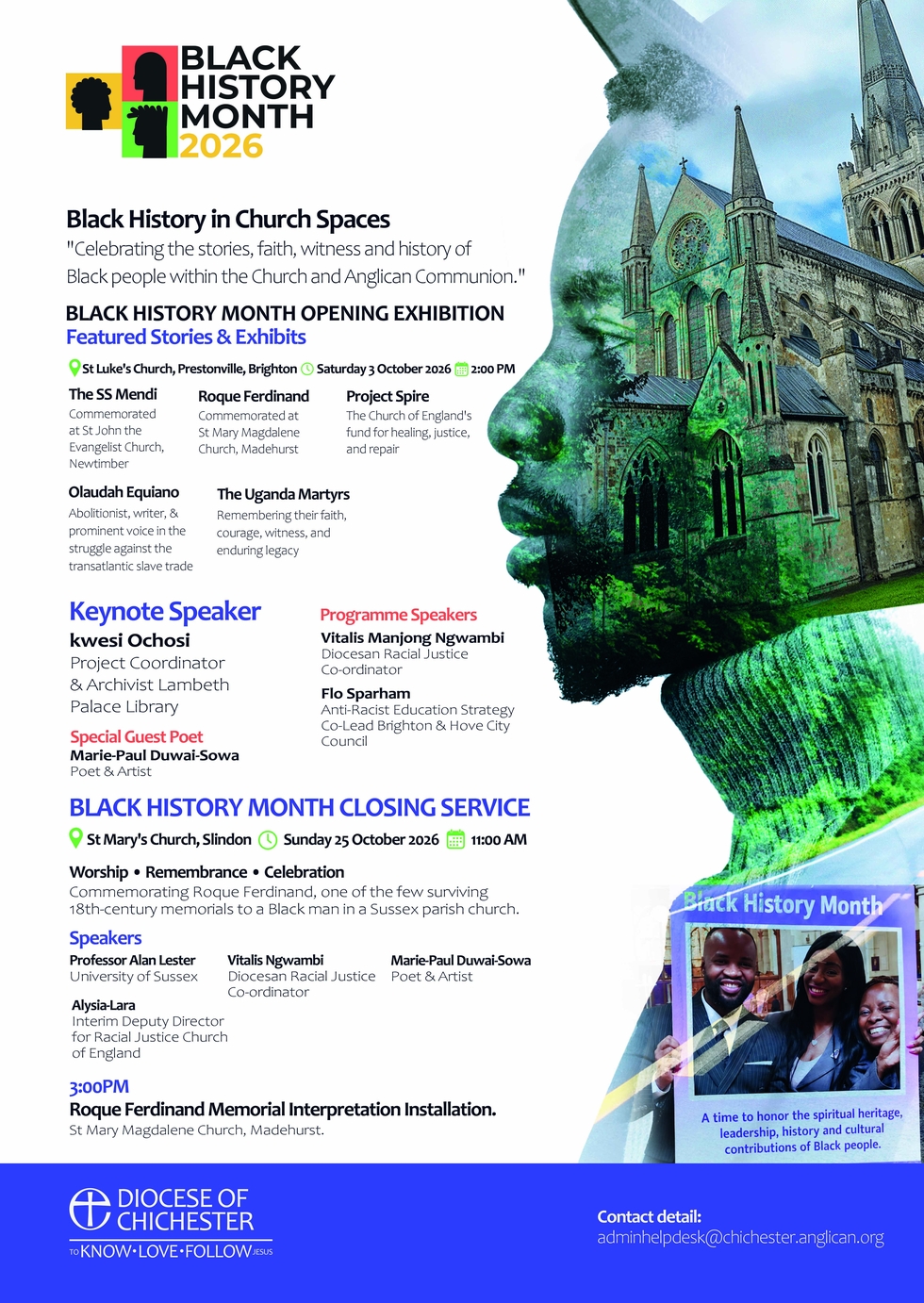
The celebrations will bring together parish communities and friends to remember, learn from and celebrate the stories of black people whose lives, faith and contributions are part of the history of the Church and wider British society.
Black History Month opens with an exhibition at St Luke’s Prestonville on Saturday, October 3, from 2pm and close with an 11am commemorative service at St Mary’s in Slindon on Sunday, October 25 followed by a visit to St Mary Magdalene Madehurst at 3pm to mark the memorial to Roque Ferdinand, a servant and formerly enslaved man, one of the very few surviving eighteenth century memorials to a Black man in a Sussex parish church.
Racial justice co-ordinator Vitalis Ngwambi has been instrumental in bringing the programme together.
He said: “I felt it was important to rethink how we approach and celebrate Black History Month. Too often, black history is presented as something distant from our own communities while the stories embedded in our local parishes and the diocese remain overlooked.
“There is an African proverb that says ‘a river that forgets its source will soon dry up’. Beginning with our local parish is therefore more than a starting point, it is an invitation to look closely at the histories that have shaped our communities and enriched the life of the Church but which have too often been forgotten or overlooked.
“This exhibition connects the local with the national and international, revealing the many ways black history is woven into the story of our churches and communities. Above all, it seeks to recognise people whose lives and contributions have too often been overlooked, reaffirming their humanity, dignity and enduring contribution to the Church, the Anglican Communion and the wider world.” Black History Month is an opportunity to recognise the contribution of black communities and to promote a fuller and more inclusive understanding of British history.
The exhibition at St Luke’s Prestonville will explore significant stories that connect black history, faith and church spaces. They include that of the SS Mendi, the troopship that sank in 1917, resulting in the deaths of more than 600 black South African servicemen. Their sacrifice is remembered through a memorial plaque at St John the Evangelist Church, Newtimber.
The exhibition will also explore Project Spire, the Church of England’s work for healing, justice and repair, reflecting on its responsibility to confront difficult histories and pursue a more just future.
Visitors will be able to read about the life of Olaudah Equiano, the black abolitionist and Christian whose experiences and campaign against slavery remind us of the powerful role that Christian faith and church communities played in shaping the movement for the abolition of slavery.
The exhibition will also remember the Uganda Martyrs, 45 Christian converts who were executed for their Christian faith. Their story is one of courage, conviction and sacrifice.
The stories demonstrate that black history is not separate from the history of the Church. It is part of our shared story of faith, witness, struggle, sacrifice and hope. The keynote speaker will be Kwesi Ochosi, project co-ordinator and archivist at Lambeth Palace Library, who will help us explore the importance of archives, memory and the stories preserved within the Church.
The service at Slindon will feature Professor Alan Lester of the University of Sussex as guest speaker alongside Alysia Lara, interim deputy director of racial justice. It will provide an opportunity for prayer, remembrance and reflection as we consider how the Church remembers its past and how that memory can shape its future.
After the service, people will make the short journey to St Mary Magdalene Madehurst where there is a plaque to Roque Ferdinand, a West African from the Cape Verde island of Bonavista. He was purchased into enslavement at the age of 15 by Sir George Thomas Bart, governor of the Leward Islands. Sir George eventually retired to Yapton and Roque was only released from slavery when Sir George died. Roque carried on in domestic service for the family, dying in 1789 aged 67. The plaque in his honour is one of few surviving 18th century memorials to a black man in a Sussex parish church.
Black History Month is also an invitation for parishes and schools across the Diocese to engage with black history throughout October and beyond. Churches Together in Britain and Ireland has brought together a collection of resources to support churches and schools, including sermons, prayers, Bible readings, songs, poems and activities.
These resources provide practical ways for communities to explore black history through worship, learning and reflection. We encourage our parishes and schools to join us in marking Black History Month using these resources and creating opportunities to listen, learn and celebrate. As the Church, we are drawn from many nations, tribes, peoples, languages and colours yet united in Christ.
Black History Month reminds us that every story matters, every person bears the image of God and every community has a contribution to make to the life of Christ’s Church.