

The Lay Apostolate: Focal Ministry
1) What is a Focal Minister?
A Focal Minister is a lay or ordained leader called out from within the local community who provides local leadership and a regular, visible presence for a single church community, within the context of a multi-parish benefice, under the authority of an Incumbent who gives oversight. Focal Ministers are likely to have a role in their church already, perhaps as a Reader, ALM or self-supporting minister.
2) What is the Focal Ministry pathway?
The Focal Ministry Pathway provides training and support for individuals to take a share in the responsibility for leading a single church within a multi-parish benefice, under the overall oversight and authority of the Incumbent. Their specific responsibilities are based on the parish context and by their own experience and training, with the details agreed collaboratively between the Focal Minister and Incumbent, and signed off by the Head of Apostolic Life.
3) What are the key facts to know about Focal Ministry?
- Having a Focal Minister won't impact the appointment of clergy. It isn't a replacement for a Vicar, but an added resource for the Parish.
- Focal Ministry is a role and not an office. It doesn't give any extra permissions, but the Focal Minister does receive a Mandate from the Bishop for ministry in a particular church.
- What changes? Focal Ministry envisages a new relationship between the church and ministry team, allowing ministers to focus on individual churches rather than being spread more thinly across multiple parishes.
4) Why do we need Focal Ministry?
Based on extensive research across the Church of England there are some key benefits of Focal Ministry:
- Personal Attention: Churches which may have previously received a small percentage of their Incumbent’s ministerial time due to him or her being spread across multiple churches, will benefit from a local individual who provides a consistent ministerial presence.
- Improved Relationships and Trust: When one minister consistently serves a congregation, members experience greater continuity. Trust grows more naturally, pastoral care becomes deeper, and relationships become stronger than when ministers rotate or cover multiple churches.
- Clearer Leadership and Vision: A focal minister can offer more consistent direction. Instead of multiple churches competing for the same leader’s energy, each church benefits from a dedicated figure who understands its unique challenges, mission field, and opportunities.
- Better Attendance and Growth: Potential Bob Jackson’s research shows that congregations with stable, focused leadership tend to maintain or increase attendance more effectively than those with irregular or shared oversight. Stability helps create momentum.
- Enhanced Local Presence: A focal minister naturally becomes embedded in the local community — more visible, accessible, and available. This strengthens the church’s public witness and makes newcomers feel more connected.
- Stronger Volunteer Engagement: Regular leadership encourages lay teams to take initiative. When a congregation feels clearly supported by its minister, more people volunteer, and ministries stay healthier.
- Reduced Burnout for Clergy: Serving one church (instead of constantly switching focus among several) gives ministers clearer rhythms and fewer conflicting demands. This contributes to increased clergy wellbeing and effectiveness
5) What are the core responsibilities and key values of a Focal Minister?

6) What might a Focal Minister do?
Each parish is different, and each Focal Minister brings different skills and experience. A Role Description would be agreed between the Incumbent and Focal Minister, and their tasks might include:
- Outreach and welcome
- Prayer/study groups
- Pastoral care
- Children, families and schools
- Organising occasional offices
- Web/social media
- Generosity and giving
- Local partnerships
- Worship
- Mission and evangelism
- Governance and PCC
- Civil/social action
- Buildings and churchyards
- Developing teams
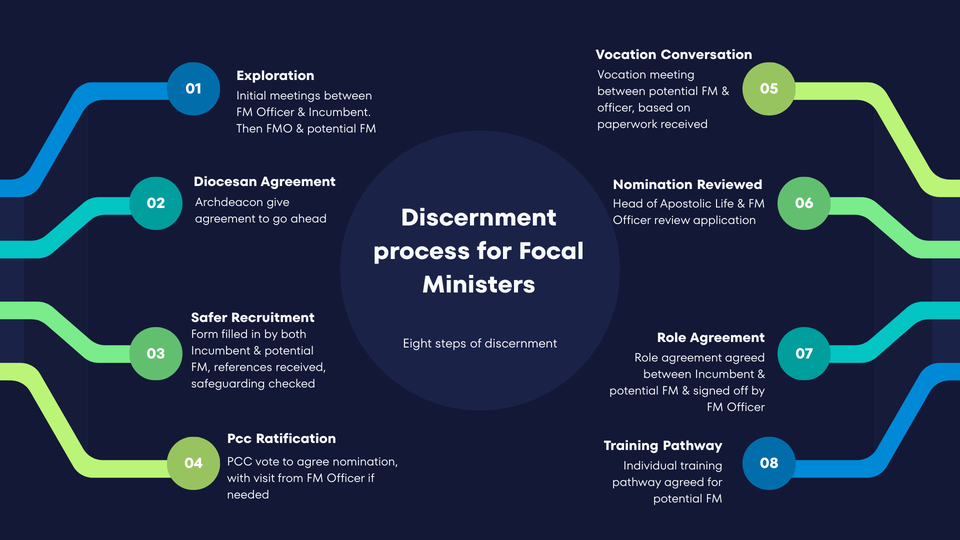
7) What is the discernment process for Focal Ministers?
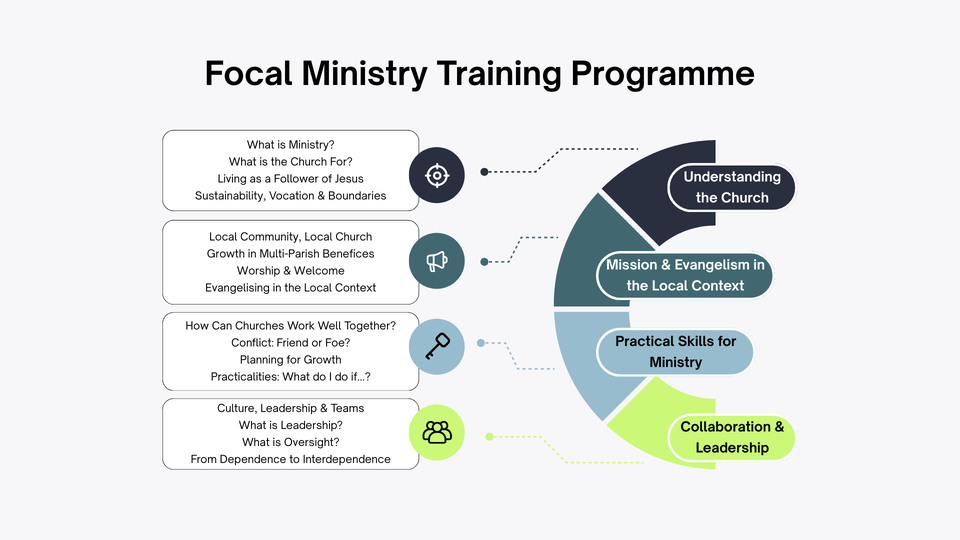
8) What is the Focal Ministry Training Programme?
9) What is the authorisation and review process for Focal Ministers?
Focal Ministers will receive a Mandate from the Bishop for their ministry once they begin their training. They should have regular meetings with their Incumbent, with a yearly written up review which is sent to the Focal Ministry Officer. The Focal Ministry Officer will be available for help and advice.
If you'd like to know more information please contact the Focal Ministry Officer.